Appendix vs. Strong-Side Carry: Which Carry Position Works for City Life?
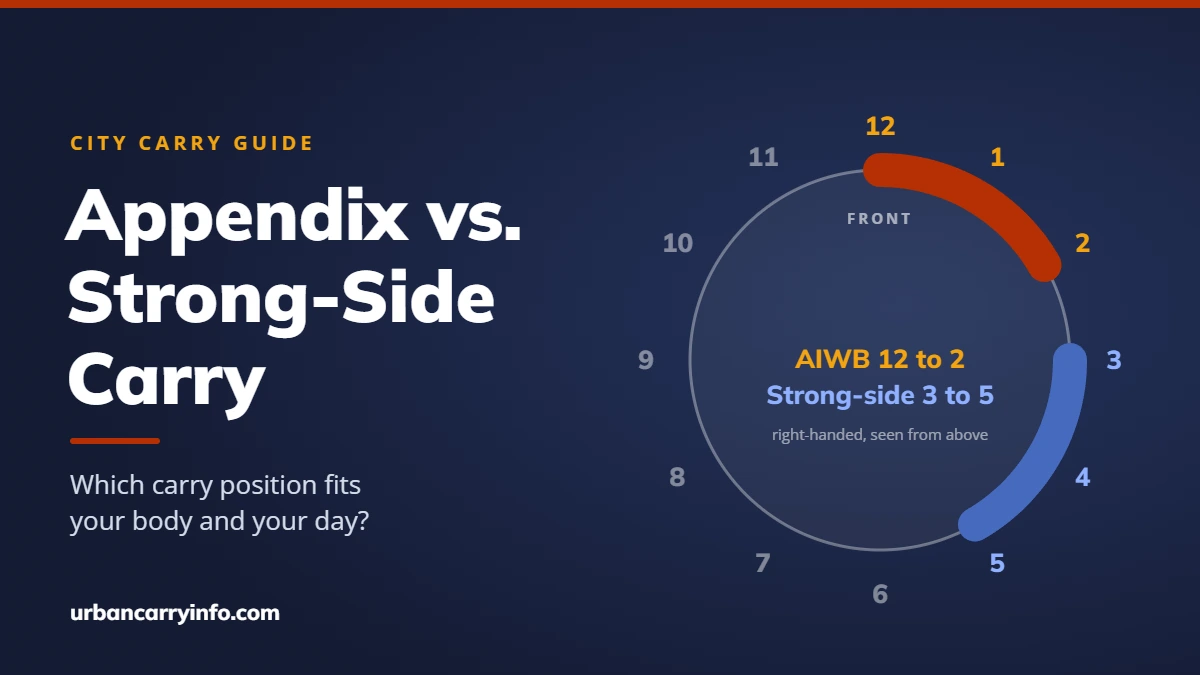
Ask ten carriers where they wear their gun and you’ll get eleven answers (somebody always changes their mind halfway through). The two you’ll hear most are appendix and strong-side, and both have loyal fans for good reason.
Here’s the thing: there’s no holy grail carry position. What disappears on a slim guy in a hoodie can dig into a bigger guy every time he sits down. Your body, your wardrobe, and your day get the final vote.
So let’s break down appendix vs. strong-side carry: how each position works, who it tends to fit, and how to test both before you spend money on a holster.
Appendix vs. strong-side carry at a glance
| Appendix (AIWB) | Strong-side IWB | |
|---|---|---|
| Where it sits | Front of the waistband, between your belly button and hip bone | On your dominant hip, roughly 3 to 5 o’clock for right-handers |
| Concealment | Very good; the gun follows the curve of your stomach | Good under an untucked shirt or jacket; the grip can print when you bend |
| Draw | Short, direct path to the gun | Longer reach around your side |
| Sitting | Can dig in, especially if the gun rides too low | Often more comfortable, but not for everyone |
| Body type | Often easier for slimmer waists | Often easier for bigger midsections |
| Biggest watch-out | The muzzle points toward your groin and thighs, so reholstering has to be slow | Printing at the hip and needing a longer cover garment |
What do the clock positions mean?
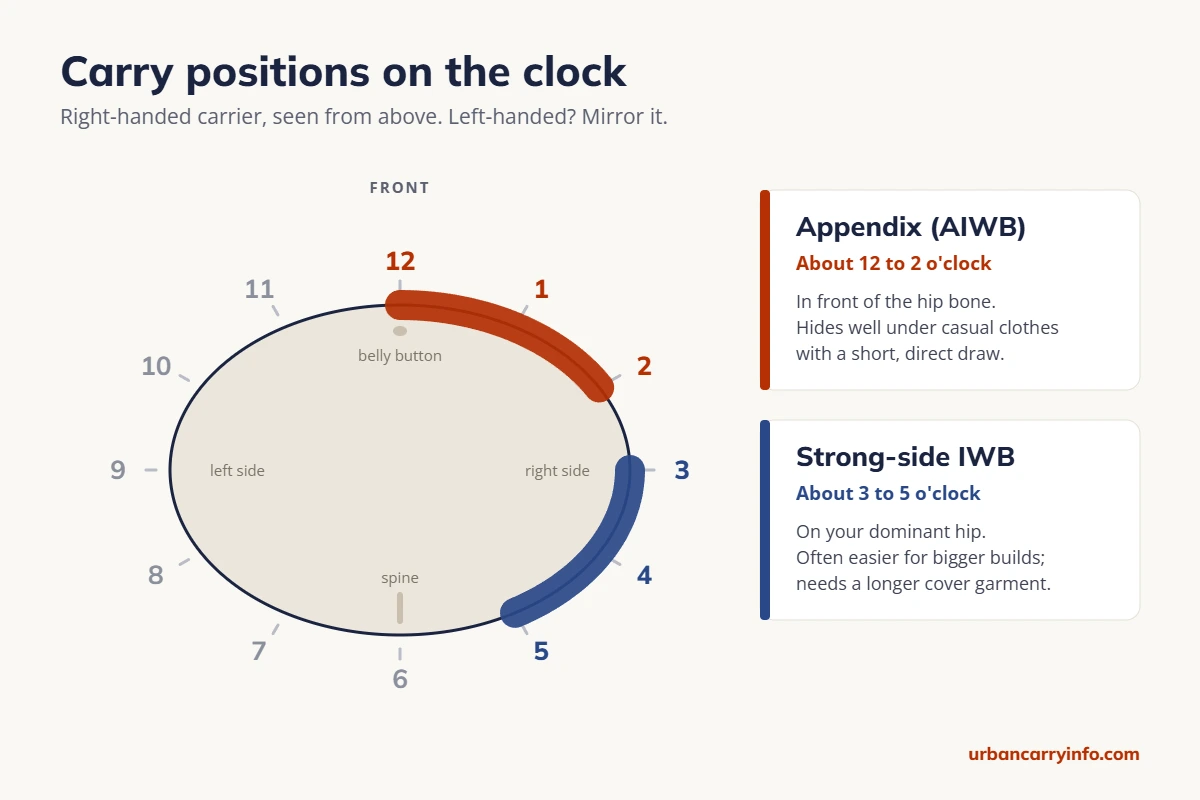
Picture a clock face laid on your waistline, seen from above. Twelve o’clock is your belly button and six o’clock is your spine. For a right-hander:
- Appendix (AIWB) sits in front of the hip bone, around 12 to 2 o’clock. Holster makers draw the zone a little differently (PHLster describes anywhere from 10 to 2), so treat the numbers as a neighborhood, not an address.
- Strong-side sits on your dominant hip, around 3 to 5 o’clock. The 4 to 5 o’clock range is what most people mean by “behind the hip.”
Left-handed? Flip everything to the other side of the clock. And “IWB” just means inside the waistband: the holster rides inside your pants, with a clip or loops holding it to your belt. We’re comparing the IWB version of both positions because that’s what hides best in the city.
Why so many city carriers go appendix
Concealment is the big one. In appendix, the gun follows the natural curve of your stomach, so it’s less likely to print. On the hip, a pistol tends to create an obvious lump on one side of your body. Up front, it blends in.
The draw is also shorter. Your hands are already working in front of you all day, and there’s less distance between them and the gun. That said, a smooth draw comes from practice, not from where the holster sits. A well-trained strong-side carrier will beat an untrained appendix carrier every time.
It also keeps the gun in front of you, where your arms naturally cover it on a packed train or in a line at the coffee shop.
The trade-offs nobody should skip
Sitting can be rough. Appendix carry is often less comfortable seated, and that matters if you spend your day at a desk or behind the wheel. The good news: the most common reason is a gun riding too low, which is fixable (more on that below).
The muzzle points at parts of you that you’d like to keep. Holstered in appendix, the muzzle can point toward your groin and the femoral artery in your thigh. The USCCA notes that most accidental discharges happen while drawing or holstering, and that’s exactly when appendix carry demands the most care.
That doesn’t make appendix unsafe. It makes it unforgiving of sloppy habits. If you carry appendix, these aren’t optional:
- Use a holster made for appendix carry that fully covers the trigger guard.
- Before you reholster, move your shirt and jacket completely out of the way so nothing can snag the trigger.
- Tilt your hips forward so the holster’s muzzle end angles away from your body.
- Watch the gun go into the holster, slowly. Reholstering is not a race. If anything feels like it’s catching, stop and fix it.
Body type matters. People with smaller waists tend to find appendix more comfortable, while bigger guys and gals often find strong-side easier to live with. “Tend to” is doing a lot of work in that sentence, though. Plenty of bigger carriers make appendix work with the right holster and ride height.
How to make appendix carry comfortable
Most appendix complaints come down to setup, not the position itself. Three things make the biggest difference:
1. Ride height. Sit down first and adjust from there. PHLster calls carrying too low the most common error, and raising the holster fixes most of the digging when you sit or bend.
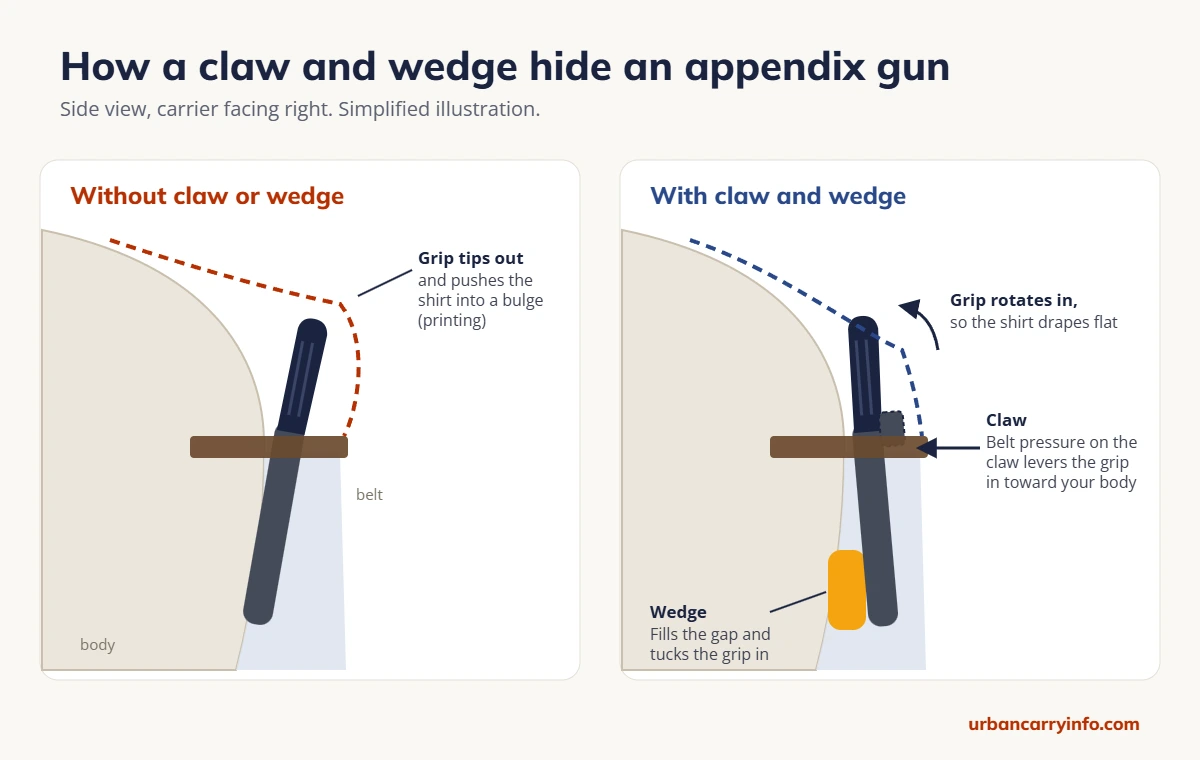
2. A claw and a wedge. A claw (sometimes called a wing) is a small arm on the holster that presses against the back of your belt. Belt pressure on the claw rotates the grip in toward your body, which kills a lot of printing. A wedge is a foam pad on the body side of the holster, down near the muzzle. It fills the gap between the holster and your body and tucks the grip in even more.
3. The right belt. Claws only work with belt tension, so a flimsy dress belt that sags under the weight won’t cut it. You want a belt that holds tension and follows your body. Interestingly, PHLster points out that a belt so stiff it keeps its own round shape can pull the gun away from you, so “stiffer” isn’t automatically “better.”
Strong-side carry: the classic for a reason
Strong-side IWB is where a lot of people start, and plenty never leave. For many carriers (especially bigger folks), it’s simply more comfortable, and a lot of people find it easier to live with in a desk chair.
Many strong-side holsters tilt the gun forward a bit. That angle is called cant, and it helps you get a full grip on the draw while tucking the butt of the gun under your shirt instead of letting it poke straight out.
The muzzle also points down and away from the big blood vessels in your legs, which a lot of people find reassuring, especially while they’re still building their holstering habits.
Where strong-side falls short
- Printing when you move. Bend over to tie your shoes or reach for the top shelf, and the grip can push your shirt out like it’s trying to say hello.
- Longer cover garments. You need a shirt or jacket long enough to cover the grip on your hip, even when you raise your arms.
- Tight spaces. In a car seat or a packed booth, a gun behind your hip can end up pinned between you and the seat, which makes it harder to reach.
- Comfort isn’t guaranteed. Some carriers find strong-side uncomfortable when sitting too. Bodies are weird like that.
Which position fits your body and your day?
Use this as a starting point, not a rulebook:
- Slimmer build, untucked tees and hoodies: appendix is worth trying first. It’s hard to beat for concealment under casual clothes.
- Bigger midsection: strong-side is often more comfortable, but don’t rule out appendix with a holster built for it and a higher ride height.
- Desk job, long hours seated: test both positions sitting down before you commit. Comfort while seated is where most setups win or lose.
- Tucked shirts and business clothes: look for a tuckable IWB holster in either position. Our guide for professionals covers carrying with business attire.
- You drive a lot: sit in your car with your seatbelt on and see where the gun ends up. And remember the rules for guns in vehicles change from place to place, so check our city carry law guides.
- You ride transit: before you worry about position, make sure you can carry on your bus or train at all. Our public transit carry laws breakdown covers the major cities.
Test both before you commit
The only opinion that really matters here is your body’s. Before you buy (or before you carry a new setup in public), run a test at home with an unloaded, double-checked firearm and the ammo in a different room:
- Wear it for a few hours doing normal stuff around the house.
- Sit in your desk chair, on the couch, and in the car with the seatbelt on.
- Bend to tie your shoes and reach overhead, then check a mirror for printing.
- Practice the draw and the slow, deliberate reholster until both feel automatic.
Then get real instruction. A good class will catch habits you can’t see yourself, especially on the reholster.
Whatever you pick, the holster has to be right
Position is only half the setup. In either spot, your holster should:
- Cover the trigger guard completely
- Be made for your exact pistol model, not one that’s “close enough”
- Click in and hold the gun securely when you move
- Keep its mouth open after the draw so you can reholster one-handed
- Stay attached to your belt when the gun comes out
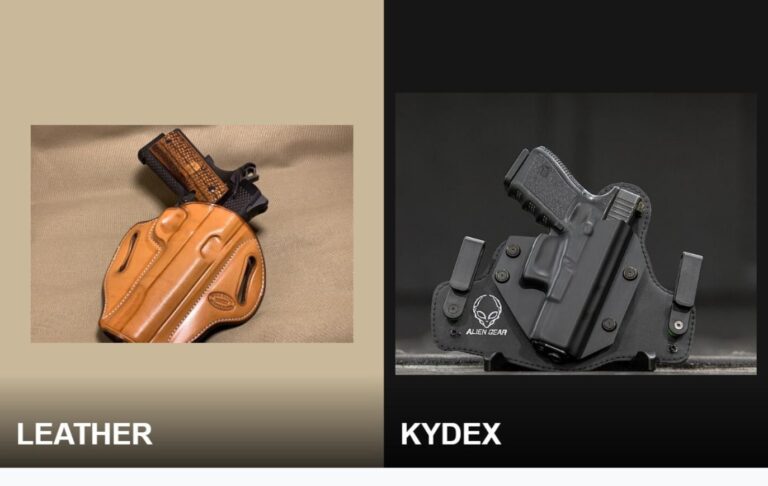
Wondering about materials? Our leather vs. Kydex breakdown covers which one fits which situation.
Disclosure: the Rounded link below is an affiliate link. If you buy through it, we may earn a commission at no extra cost to you.
If you want a place to start shopping, Rounded by Concealment Express makes its Kydex IWB holsters in the USA, including tuckable models, and you shop by your gun make so the fit is exact. Code RGSAMMIE gets you 15% off.
Find what works for you
Appendix or strong-side, the right answer is the one you’ll actually carry every day: hidden, comfortable, and handled safely every single time it goes in and out of the holster.
Ready to build out the rest of your setup? Start with our concealed carry gear guide, and check the carry laws for your city before you head out.
Try things on, move around in them, sit down in them. Find what works for your body and your day.
Sources: USCCA, What Is Appendix Carry; PHLster, How to Appendix Carry Comfortably; Safariland, Appendix vs. Strong Side; ConcealedCarry.com, Clawing and Wedging Your Way to Perfect Holster Fit.

Comments