
Maryland Expungement Guide (2026): How to Clear Your Record and Qualify for an HQL
How to Expunge Your Record to Qualify for a Maryland Handgun Qualification License (HQL)
If you have a criminal record in Maryland that’s preventing you from obtaining a Handgun Qualification License (HQL), expungement may be your path forward. This guide walks you through the entire expungement process specifically for those seeking to qualify for an HQL in Maryland.
Maryland law requires residents to possess a valid Handgun Qualification License before purchasing, renting, or receiving a handgun. However, certain criminal records can disqualify you from obtaining this license. Understanding the expungement process is crucial for restoring your firearm rights.
Understanding Maryland Expungement Eligibility
Before beginning the expungement process, you need to determine if your record is eligible for expungement. Not all criminal records can be expunged in Maryland.
Records Eligible for Expungement
The following dispositions may be eligible for expungement:
- Acquittal (found not guilty)
- Dismissal of charges
- Probation Before Judgment (PBJ) (except for certain offenses)
- Nolle Prosequi (charges dropped by prosecutor)
- Stet (case indefinitely postponed)
- Not Criminally Responsible finding
- Certain guilty dispositions (after waiting periods)
Records NOT Eligible for Expungement
You are NOT eligible if:
- You have pending criminal charges
- The charge was part of a unit where other charges resulted in a conviction (unless all charges in the unit are eligible)
- You are currently serving a sentence for another crime
- The conviction is not eligible under Maryland law
Waiting Periods for Expungement
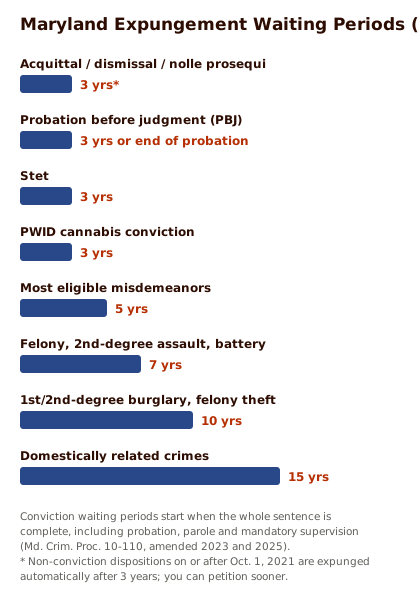
The waiting period before you can file for expungement depends on the disposition of your case.
If you weren’t convicted
- Acquittal, Dismissal, Not Guilty, Nolle Prosequi:
- Disposition on or after October 1, 2021: Automatically expunged after 3 years, or you can petition sooner with Form CC-DC-CR-072C
- Disposition before October 1, 2021: You can petition any time. However, filing within 3 years of the disposition means also filing a General Waiver and Release, Form CC-DC-CR-078 (§ 10-105(c))
- Probation Before Judgment (PBJ):
- General rule: You can file once you are discharged from probation or 3 years after the PBJ was granted, whichever comes later (§ 10-105(c))
- DUI/DWI PBJs: These follow stricter rules. Specifically, you are not eligible if, within 15 years after the PBJ, you are convicted of anything other than a minor traffic violation or get another DUI PBJ (§ 10-105(e)). Talk to a lawyer about timing
- Stet: Must wait 3 years after the case was marked stet
If you were found guilty
- Most eligible misdemeanors: 5 years after you complete the sentence, including any probation, parole, or mandatory supervision (reduced from 10 years by the REDEEM Act of 2023, Md. Crim. Proc. § 10-110(c))
- Eligible felonies: 7 years after completion of sentence. Two exceptions run longer or shorter: first- and second-degree burglary and felony theft are 10 years, and possession with intent to distribute cannabis is 3 years
- Second-degree assault (Md. Crim. Law § 3-203) and common law battery: 7 years after completion of sentence (cut from 15 years by the REDEEM Act)
- Offenses classified as domestically related crimes: 15 years after completion of sentence. However, these did not get the REDEEM Act reduction
- Also note two disqualifiers in § 10-110(d). First, a new conviction during the waiting period blocks expungement of the earlier one until the new conviction itself becomes eligible. Second, no one with a pending criminal case is eligible. Separately, § 10-105.4 provides that unpaid court costs are not a bar to expungement.
What changed in 2025 and 2026
Maryland has tweaked its expungement law two years in a row, so older guides (and some court pages) can be out of date. Here’s what’s new:
- The clock starts when your sentence is complete. The Expungement Reform Act of 2025 (Chapter 95, effective October 1, 2025) replaced the old “satisfactory completion” language with “completion of the sentence,” meaning the sentence has expired, including any probation, parole, or mandatory supervision. That matters if you ever had a probation violation, which courts had used to deny petitions under the old wording.
- More misdemeanors qualify. The same law added credit card theft (Criminal Law § 8-204) and driving without a license (Transportation § 16-101) to the list of convictions you can petition to expunge.
- Judges weigh your track record. Courts now consider how you did on probation, parole, or supervision, and whether restitution was paid (or whether you’re unable to pay it).
- Case Search hides more. Since January 31, 2026, Maryland Judiciary Case Search can’t show stets that are at least three years old, nolle prosequi dispositions that required drug or alcohol treatment, or cannabis possession convictions the Governor later pardoned. Heads up: disappearing from Case Search is not the same as an expungement. The record still exists until a court orders it expunged.
- “No finding” cases. Starting October 1, 2026, Chapter 466 of 2026 lets you petition to expunge an eligible conviction even when another charge in the same case ended with a “no finding” designation, or the case was terminated without a finding. Before, those leftover charges could block the whole case under the “unit rule.”
- No automatic expungement for convictions (yet). A 2026 “Clean Slate” bill (HB 360) would have made expungement of many eligible records automatic, but it didn’t pass. For convictions, you still have to file a petition.
Step-by-Step Expungement Process for HQL Qualification
Step 1: Obtain Your Criminal Record
Before filing for expungement, you need to know exactly what’s on your record.
- Request your Criminal History Record from the Maryland Criminal Justice Information System (CJIS)
- Visit: Maryland CJIS Central Repository at 6776 Reisterstown Road, Suite 102, Baltimore, MD 21215
- Provide fingerprints (fee applies)
- Or request online at www.dpscs.state.md.us
- Obtain Certified Copies of Court Records
- Visit the courthouse where your case was handled
- Request certified copies of all case documents
- Note the case number, date of arrest, and disposition for each charge
Step 2: Determine the Correct Expungement Form
Maryland uses different expungement petition forms based on your case disposition:
- Form CC-DC-CR-072A: For cases with dispositions of acquittal, dismissal, PBJ, nolle prosequi, stet, or not criminally responsible
- No filing fee required
- Form CC-DC-CR-072B: For eligible guilty dispositions (non-marijuana related)
- $30 filing fee per case (can be waived if indigent)
- Form CC-DC-CR-072C: For acquittal, dismissal, not guilty, or nolle prosequi dispositions entered on or after October 1, 2021 (when requesting expungement earlier than the automatic 3-year period)
- No filing fee required
- Form CC-DC-CR-072D: For marijuana/cannabis-related guilty dispositions
- Ask the clerk about any filing fee; you can request a fee waiver if you can’t afford it
Step 3: Complete the Appropriate Expungement Petition
Let’s focus on completing Form CC-DC-CR-072A (the most common form for non-conviction records):
- Fill in the Court Information:
- Select the court where your case was heard (District or Circuit)
- Enter the city or county
- Enter Case Information:
- Case number
- Date of arrest, citation, or summons
- Law enforcement agency
- Statement of charges
- List All Charges you want expunged:
- Include each charge number
- Exact wording of the charge
- Disposition of each charge
- Provide Your Information:
- Full name
- Address
- Date of birth
- Sex
- Last 4 digits of Social Security number
- Sign and Date the petition
- Follow the signature instructions on the current version of the form
Step 4: File the Petition
- Submit the Petition to the court where your case was handled:
- File in person at the court clerk’s office
- Include all required copies (original plus additional copies)
- Pay filing fee if applicable ($30 for guilty dispositions)
- Keep a copy for your records
- Request a Fee Waiver if needed:
- Complete Form CC-DC-089 (Request for Waiver of Prepaid Costs)
- Provide financial information to demonstrate inability to pay
Step 5: Serve the Petition
After filing, you must serve copies of your petition on:
- The State’s Attorney’s Office in the county where you filed
- Deliver in person or by certified mail
- Keep proof of service
- The Law Enforcement Agency that arrested you
- Deliver in person or by certified mail
- Keep proof of service
Step 6: Wait for Responses
After service, the State’s Attorney and law enforcement agencies have 30 days to file objections:
- If No Objection is Filed:
- The court will grant the expungement without a hearing
- Skip to Step 8
- If an Objection is Filed:
- The court will schedule a hearing
- Proceed to Step 7
Step 7: Attend the Hearing (If Required)
If a hearing is scheduled:
- Prepare Your Case:
- Gather all supporting documents
- Consider consulting an attorney
- Prepare to explain why expungement should be granted
- Attend the Hearing:
- Arrive early
- Dress professionally
- Present your case clearly and respectfully
- Answer any questions from the judge
- Receive the Judge’s Decision:
- The judge may rule immediately or take the matter under advisement
- If granted, proceed to Step 8
- If denied, consult with an attorney about possible appeals
Step 8: Receive the Order for Expungement
If your expungement is granted:
- The Court Will Issue an Order for Expungement
- This will be sent to all relevant agencies
- Agencies Have 60 Days to Comply
- They must remove your records from public access
- They must send a Certificate of Compliance to the court
- You Will Receive a Certificate of Compliance
- Keep this document permanently
- This is proof your record has been expunged
Step 9: Verify the Expungement
After receiving all Certificates of Compliance:
- Check Your Criminal Record again after 90 days
- Request a new copy of your criminal history
- Verify the expunged charges no longer appear
- If Records Still Appear:
- Contact the court clerk
- Provide copies of your expungement order and Certificates of Compliance
- Request immediate compliance
Applying for a Maryland HQL After Expungement
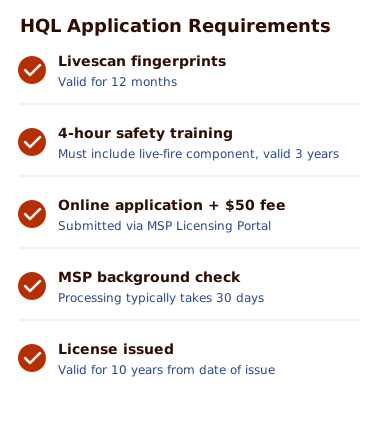
Once your record is successfully expunged, you can apply for your Maryland Handgun Qualification License:
Step 1: Complete the HQL Prerequisites
- Submit Livescan Fingerprints
- Visit an authorized fingerprinting provider
- Request fingerprinting for an HQL application
- Keep the receipt (required for application)
- Fingerprints are valid for 12 months
- Complete the Required Firearms Safety Training
- Must be taught by a Qualified Handgun Instructor
- Minimum 4 hours of instruction
- Must include live-fire component
- Training certificate valid for 3 years
Step 2: Apply for the HQL Online
- Create an Account on the Maryland State Police Licensing Portal
- Start at the Maryland State Police Handgun Qualification License page
- Apply through the eMDSP Online Services portal linked from that page
- Create a user account with a valid email address
- Complete the Application:
- Enter all required personal information
- Upload a copy of your Livescan fingerprint receipt
- Upload your firearms safety training certificate
- Answer all questions truthfully. What you must disclose about an expunged charge is genuinely tricky: Md. Crim. Proc. § 10-109 generally allows a person to deny an expunged charge, but a firearms application raises state and federal questions at the same time, and a wrong answer carries its own penalties. Ask an attorney how to answer rather than guessing from a guide
- Pay the Application Fee:
- $50 for new applications
- Payment by credit card
Step 3: Background Check and Processing
- Maryland State Police Will Conduct a Background Check
- This includes criminal history review
- Your expunged records should not appear or affect this check
- Application Processing:
- MSP must notify you of its decision within 30 days of receiving a complete application
- You can check status online through your account
- Receive Your HQL:
- If approved, your HQL will be emailed to you
- Print and keep this license
- Valid for 10 years from date of issue
Special Considerations for Expungement and HQL
Pardons
If your offense is not eligible for expungement, you may need to seek a pardon:
- Apply for a Pardon from the Governor
- Visit: https://dpscs.maryland.gov/publicservs/pardons.shtml
- Complete the pardon application
- Waiting periods apply: 5 years for misdemeanors, 10 years for most felonies (the Parole Commission can consider some at 7), and 15 to 20 years for violent crimes and drug felonies
- After Receiving a Pardon:
- A pardon is not an expungement by itself. But if you were convicted of only one criminal act, it was not a crime of violence, and you received a full and unconditional pardon, you can petition to expunge it within 10 years of the pardon (§ 10-105(a)(8))
- Follow the expungement process outlined above
Out-of-State Convictions
If you have criminal records from other states:
- You Must Expunge Each Record in the State Where it Occurred
- Each state has different expungement laws and procedures
- Contact the court in that state for information
- Federal Convictions:
- Federal convictions have a separate expungement process
- Many federal convictions cannot be expunged
- Consult a federal attorney for guidance
Legal Assistance
Consider seeking legal help for complex cases:
- Maryland Legal Aid:
- Free legal services for low-income individuals
- Visit: https://www.mdlab.org/
- Maryland Volunteer Lawyers Service:
- Pro bono (free) legal assistance
- Visit: https://mvlslaw.org/
- Private Attorneys:
- Many offer free consultations
- Fees vary but may be worth the investment for complex cases
Conclusion
Expunging your record to qualify for a Maryland HQL requires patience and attention to detail. Expect the process to take a few months: the State’s Attorney gets 30 days to object, a hearing adds time if there is an objection, and agencies then get up to 60 days to comply with the order.
Remember that expungement removes your record from public view, but certain government agencies may still have access to expunged records under specific circumstances. However, for HQL purposes, an expunged record should not prevent you from qualifying, assuming you meet all other requirements.
By following this guide and completing each step carefully, you can navigate the expungement process successfully and move forward with your Maryland HQL application. For how state and local carry rules fit together once you’re licensed, see our guide to concealed carry laws by city.
Planning to carry in public, not just own a handgun? The Wear and Carry Permit has its own eligibility rules, including disqualifying convictions, so clearing an eligible record can matter there too. Our Maryland Wear and Carry Permit guide covers the requirements, training, and application process.
Maryland expungement FAQ
How much does it cost to expunge a record in Maryland?
Petitions for non-conviction dispositions (acquittal, dismissal, nolle prosequi, stet, PBJ) generally don’t carry a filing fee. Petitions for eligible guilty dispositions cost $30 per case. If you can’t afford it, ask for a fee waiver with Form CC-DC-089. Lawyer fees are separate, and free help is available through Maryland Legal Aid and the Maryland Volunteer Lawyers Service.
How long does an expungement take?
Usually a few months. The State’s Attorney and the arresting agency get 30 days to object after they’re served. With no objection, the court can grant the petition without a hearing; with one, you’ll get a hearing date. After an order, agencies have up to 60 days to comply.
Can I expunge a DUI in Maryland?
A DUI or DWI conviction generally can’t be expunged, because Transportation § 21-902 isn’t on the list of expungeable convictions in Criminal Procedure § 10-110. A DUI PBJ can be, but under stricter rules: you’re not eligible if, within 15 years of the PBJ, you’re convicted of anything other than a minor traffic violation or get another DUI PBJ (§ 10-105(e)).
Does an expungement restore my gun rights?
It can remove the record that was blocking you, which is the whole point for most HQL applicants. Federal law also says an expunged conviction generally doesn’t count as a conviction for federal firearms purposes, unless the expungement expressly says you still can’t possess firearms (18 U.S.C. § 921(a)(20) and (a)(33)). Because state and federal rules interact, have a lawyer confirm your status before you apply for an HQL or Wear and Carry Permit.
Is expungement automatic in Maryland?
Only for some non-conviction outcomes. Acquittals, dismissals, not guilty findings, and nolle prosequi dispositions entered on or after October 1, 2021 are expunged automatically after 3 years. Convictions still require a petition.
Disclaimer
This guide is for informational purposes only and does not constitute legal advice. Laws regarding expungement and firearms qualification may change. Always consult with a qualified attorney for advice specific to your situation.
Last reviewed: October 2026. Waiting periods verified against Md. Crim. Proc. §§ 10-105 and 10-110 (as amended by the REDEEM Act of 2023, the Expungement Reform Act of 2025, and Chapter 466 of 2026), court forms against the Maryland Judiciary’s expungement forms page, pardon timelines against the People’s Law Library, and HQL requirements against the Maryland State Police HQL page.


Comments