Gun Belts for Concealed Carry: How to Pick One That Stops the Sag
The gun belt is the part of a carry setup everybody skips. People will spend hours comparing pistols and holsters, then hang the whole thing on a department-store belt that sags like it’s trying to take a nap.
That sag is where printing and a holster that won’t stay put both start. A real gun belt for concealed carry fixes it, and you don’t have to look like you’re headed to the range to wear one.
Why a regular belt doesn’t cut it
A regular dress or work belt isn’t built to carry a loaded handgun all day. It flexes under the weight, the holster tips away from your body, and the grip starts printing through your shirt. Galco puts it simply: a tighter belt helps prevent the holster sag and wobble that come from the weight of a defensive handgun.
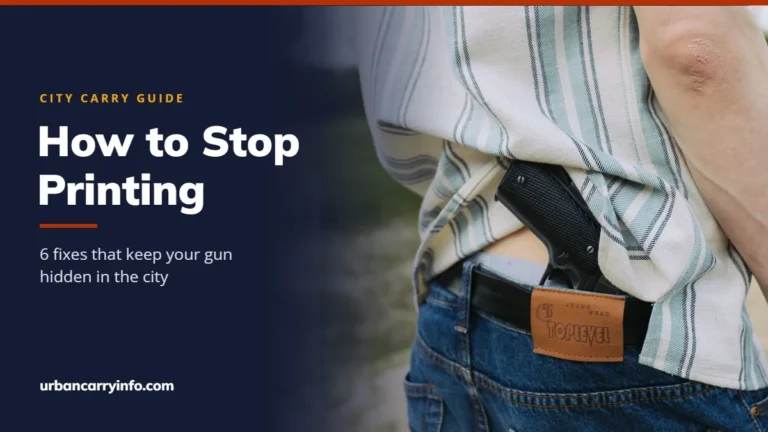
There’s a second reason. Modern holsters use a claw (or wing) that presses against your belt to rotate the grip in toward your body. No belt tension, no claw effect. Our guide to stopping printing covers how it all works together.
The three main types of gun belts
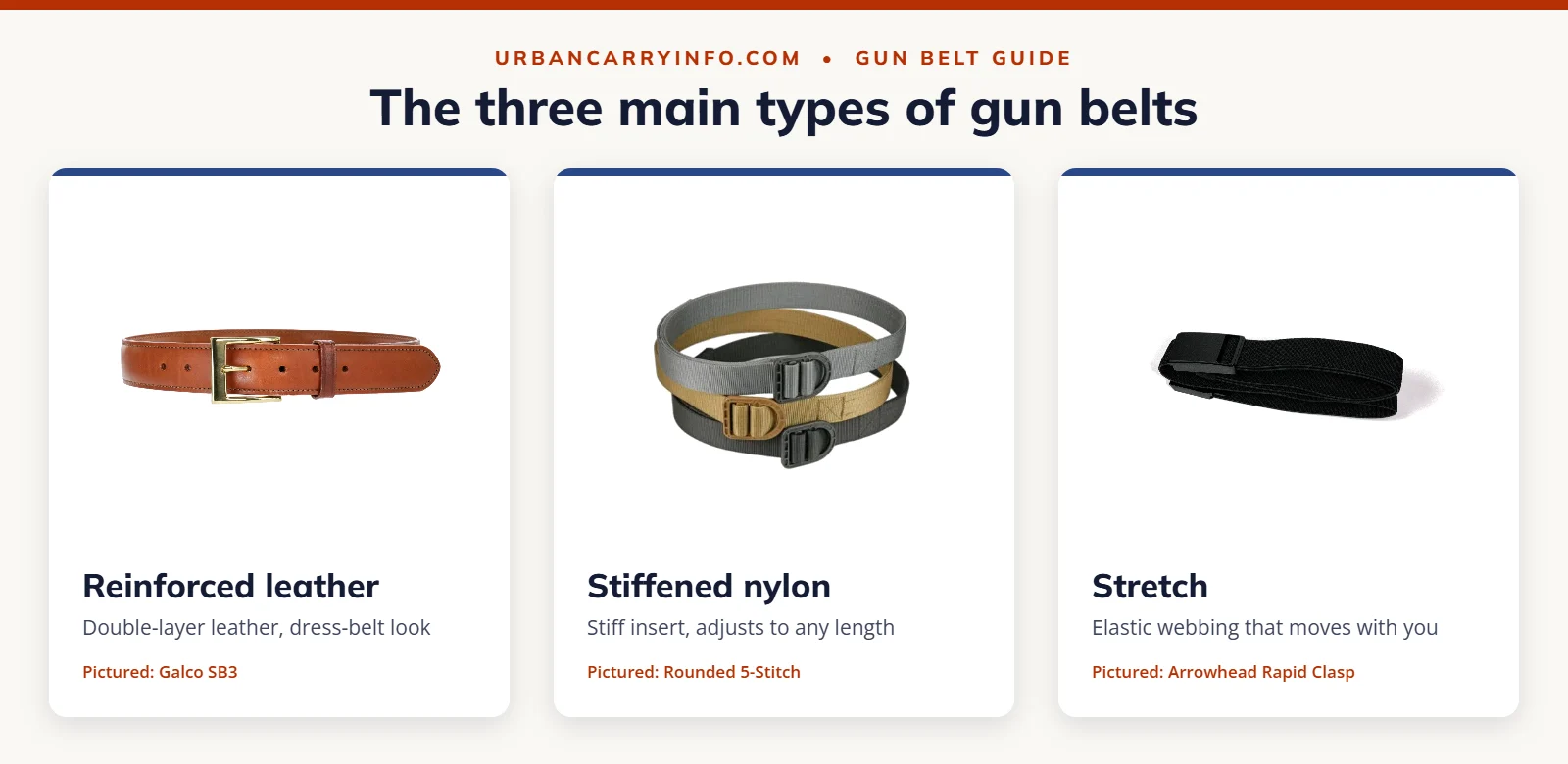
| Reinforced leather | Stiffened nylon | Stretch / adjustable | |
|---|---|---|---|
| How it’s built | Double-layer leather, stitched | Nylon webbing with a stiff insert between layers | Webbing with some elastic, often with a magnetic or ratchet-style buckle |
| Looks | Classic; passes as a dress belt | Casual; pairs with jeans and work pants | Athletic or casual |
| Adjustment | Fixed holes | Usually infinite, set it once | Infinite; some self-adjust as you move |
Reinforced leather
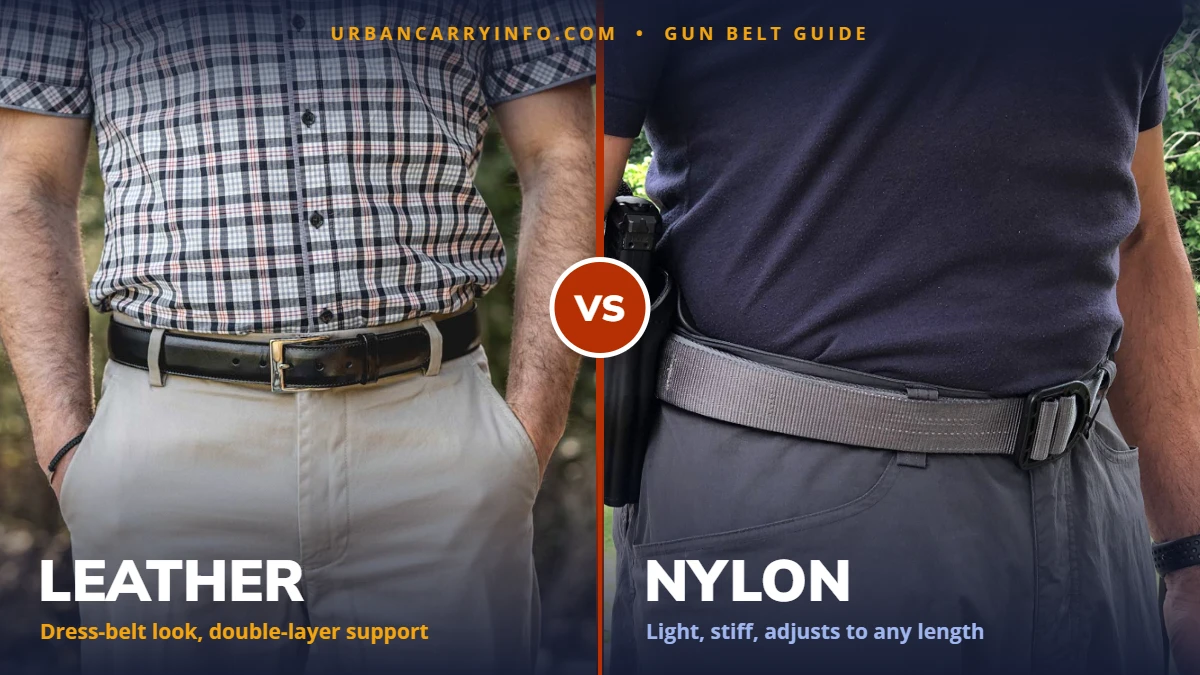
A good leather gun belt is two layers of thick leather stitched together, so it holds its shape where a single-layer belt folds. It looks like a nice dress belt, which makes it the easy pick if you carry at the office or in business casual. The trade-off is fixed holes, so you can’t fine-tune the fit between notches.
Stiffened nylon
Most nylon gun belts sandwich a stiff insert (polyethylene, Kydex or a similar material) between layers of webbing so the belt resists flexing up and down while staying comfortable around your waist. They’re lighter than leather and usually adjust to any length. Some are made with no metal at all, which frequent flyers appreciate at airport security.
Stretch and adjustable belts
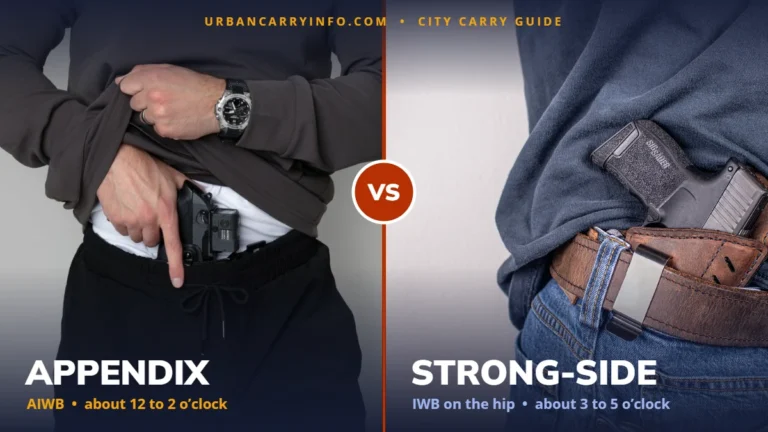
This newer category builds a little elastic into the webbing so the belt moves with your body while still supporting the gun. Ratchet-style buckles, meanwhile, let you adjust in small steps instead of full holes. These are worth a look if comfort is your main complaint, especially for appendix carry, where you want steady pressure on the holster without a belt digging into your stomach when you sit.
What width should a gun belt be?
Most gun belts come in 1.5 or 1.75 inches wide; a typical casual dress belt is closer to 1.25 inches. For everyday concealed carry, 1.5 inches is the sweet spot. It fits the belt loops on most jeans and slacks. Wider 1.75-inch belts are a little less likely to twist and sag, but they may not fit through regular pant loops.
Whatever you choose, check that your holster’s clips or loops are sized for your belt width. A 1.5-inch clip on a 1.25-inch belt will slide around.
Stiffer isn’t always better
You want a belt that resists sagging up and down, but it still has to follow the shape of your body. PHLster points out that an overly stiff belt that keeps its own rigid round shape can actually pull the gun away from your body. Look for a belt that holds tension and lies flat against you, not one that feels like a curtain rod.
How to size a gun belt
Here’s the catch: your holster takes up room inside your waistband, so your normal belt size is usually too small for inside-the-waistband carry.

- Measure with your gear on. Put on your holster (with an unloaded, double-checked gun) and any magazine carrier, then put on a belt you already own and snug it up. Measure from the end of the buckle to the hole you’re using. That’s Galco’s method, and they stress doing it while wearing your gear.
- Check the maker’s chart. Brands size differently. Rounded tells you to add 2 inches to your belt size for IWB or appendix carry, while The Beltman says adding about 5 inches to your pants size usually works for IWB. Follow the chart for the belt you’re actually buying.
- Aim for the middle. On a hole belt, you want to land near the middle holes so you can loosen it on days you carry a bigger gun or add a magazine carrier.
Which gun belt fits your day?
- Office and dress clothes: a reinforced leather belt that looks like a regular dress belt.
- Jeans and everyday city carry: a stiffened nylon belt, or leather if you like the look.
- Frequent travel: a no-metal nylon belt is easier at airport checkpoints. (Remember, the gun itself has its own rules when you travel, so check our reciprocity guide.)
- Joggers, shorts and active days: a stretch carry belt built for athletic clothes.
- Appendix carry comfort: a belt with a little stretch that keeps steady pressure on the claw without digging in when you sit.
Gun belts we partner with
Disclosure: the links below are affiliate links. If you buy through them, we may earn a commission at no extra cost to you. That never changes what we recommend.
- Galco SB3 Dress Holster Belt (leather): 1.5 inches wide, double-thickness steerhide with a dress-belt look, seven holes and a solid brass buckle, in black, havana brown or tan.
- Rounded 5-Stitch Nylon Concealed Carry Belt (nylon): 1.5-inch, 5-stitch nylon webbing with a polyethylene insert for rigidity and no metal parts, so it’s TSA compliant. Code RGSAMMIE gets you 15% off.
- Arrowhead Enhanced Rapid Clasp Retention Belt (stretch): 1.5-inch nylon-elastic webbing with a slim magnetic buckle. You set the length once, and it works with regular belt loops as well as Arrowhead’s Carrier pants and shorts.
- Constantine Carry Belt (stretch, premium): made in the USA with Hunter Constantine, designed to stretch with your body while keeping its structure, and built with appendix carry in mind.
Code URBANCARRY gets you 10% off at Arrowhead.
Find what works for you
Belt sorted? Our guide to stopping printing walks through the rest of the setup, our concealed carry gear guide covers holsters and clothing, and the carry laws for your city are worth a look before you head out.
Give a new belt a full day before you judge it. Sit in it, drive in it, bend over in it, and find what works for your body and your day.
Title photo by Fernando Huelgas on Pexels. Belt photos courtesy of Galco, Rounded and Arrowhead. Sizing photo by Juliano Goncalves on Pexels. Sources: Galco FAQ; LAS Concealment, How to Choose a Gun Belt; The Beltman, Gun Belt Sizing; PHLster, Appendix Carry Guide; product details from Galco, Rounded and Arrowhead product pages.
Comments